
 by
Your mortgage rate tells you what one loan costs. Your Life Rate is the one rate across everything you owe: the mortgage, the car loans, the credit cards, the student loans, a HELOC, each weighted by its balance. If you own a home in Las Vegas with a 3% mortgage and you are waiting for rates to come down, this is the number to run before you decide to wait.
Tom Ferry and David Childers of Keeping Current Matters walked through the national housing market on the Tom Ferry Podcast. Below, I take each of their national numbers and show what it looks like in Las Vegas and in Summerlin West, then run the Life Rate math on a calculator for two example households: one in Las Vegas and one in Summerlin.
National vs. Las Vegas vs. Summerlin West at a Glance
| National | Las Vegas | Summerlin West (89138 + 89135) | |
|---|---|---|---|
| Sales | About 4 million home sales a year for 3 years; adjusted for population, the slowest on record (David Childers) | 1,895 homes, condos and townhomes sold in October; home sales down about 12% from last year | 78 single-family homes sold; 105 came off the market unsold |
| Buyer leverage | Sellers outnumbered buyers by 62.6% in September, the biggest gap in Redfin’s records back to 2013 | Nearly 6 months of supply, up from about 4.5; 8,112 single-family homes listed without an offer, up almost 8% | 519 active listings, over 6 months of inventory; 44% of sales took a price cut first, typically about 6% |
| Prices | Flat or a little down in many markets after big run-ups | Single-family median $475,000, basically flat year over year, below the $490,000 record | Median $795,000 in 42 days; priced right: 21 days to contract vs. about 67 after a cut |
| Rates | 30-year fixed averaged 7.18% (Freddie Mac, Nov 5, 2026); Fannie Mae’s October forecast averages about 7.5% through 2027 | Same; rates are set nationally | Same |
| Forced sellers | Average homeowner equity about $310,000; about 2 of 3 mortgages under 5% | Distressed sales 1.1% of October sales; about 26% of buyers paid cash |
Update: Freddie Mac’s 30-year average is now 7.11% (Nov 12). The video’s numbers are as of Nov 5. Sources: Tom Ferry Podcast TFPE 345 with David Childers (Nov 4, 2026); Redfin (Oct 14, 2026); Freddie Mac (Nov 5, 2026); Fannie Mae October 2026 forecast; Las Vegas REALTORS October 2026 report; Summerlin West figures from The Arbeli Team’s analysis of LVR MLS single-family data pulled October 31, 2026. See the full breakdown in our October 2026 Las Vegas market update.
Put together: prices are holding in Las Vegas, buyers have more choices, rates are around 7%, and the big forecasts do not show a fast drop. If you have a 3% mortgage, you are probably telling yourself to wait. Before you do, run one number.
What Is a Life Rate?
A Life Rate is the weighted average interest rate across all of your debt. Your mortgage rate is one rate on one loan. Your Life Rate is the one rate across everything you owe, and it is the more useful number when you are deciding whether to keep a low-rate mortgage, refinance, or sell and buy.
How Do You Calculate Your Life Rate?
For each debt, multiply the balance by its interest rate. Add those amounts together, then divide by the total you owe. It is weighted by how much you owe on each one. Some quick versions just average the rates, but that overstates it when the high rates sit on small balances. The weighted version is the accurate one.
Life Rate = (balance x rate) + (balance x rate) + … ÷ total balances
You can run it yourself on our quick Life Rate calculator, or run the full Debt to Dreamhome calculator at thearbeliteam.com/liferate. The full one figures your Life Rate, then shows what happens if you sell, pay off the debt and buy the next house, side by side, down to the monthly payment.
Example 1: A Las Vegas Household With a 5.07% Life Rate
This is an example, not a real client: a Las Vegas household with a home worth about the valley’s median, $475,000.
| Debt | Balance | Rate |
|---|---|---|
| Mortgage | $320,000 | 3.25% |
| Car loan | $45,000 | 8.9% |
| Credit cards | $28,000 | 19.71% (Bankrate’s national average, Nov 4, 2026) |
| Total | $393,000 | Life Rate 5.07% |
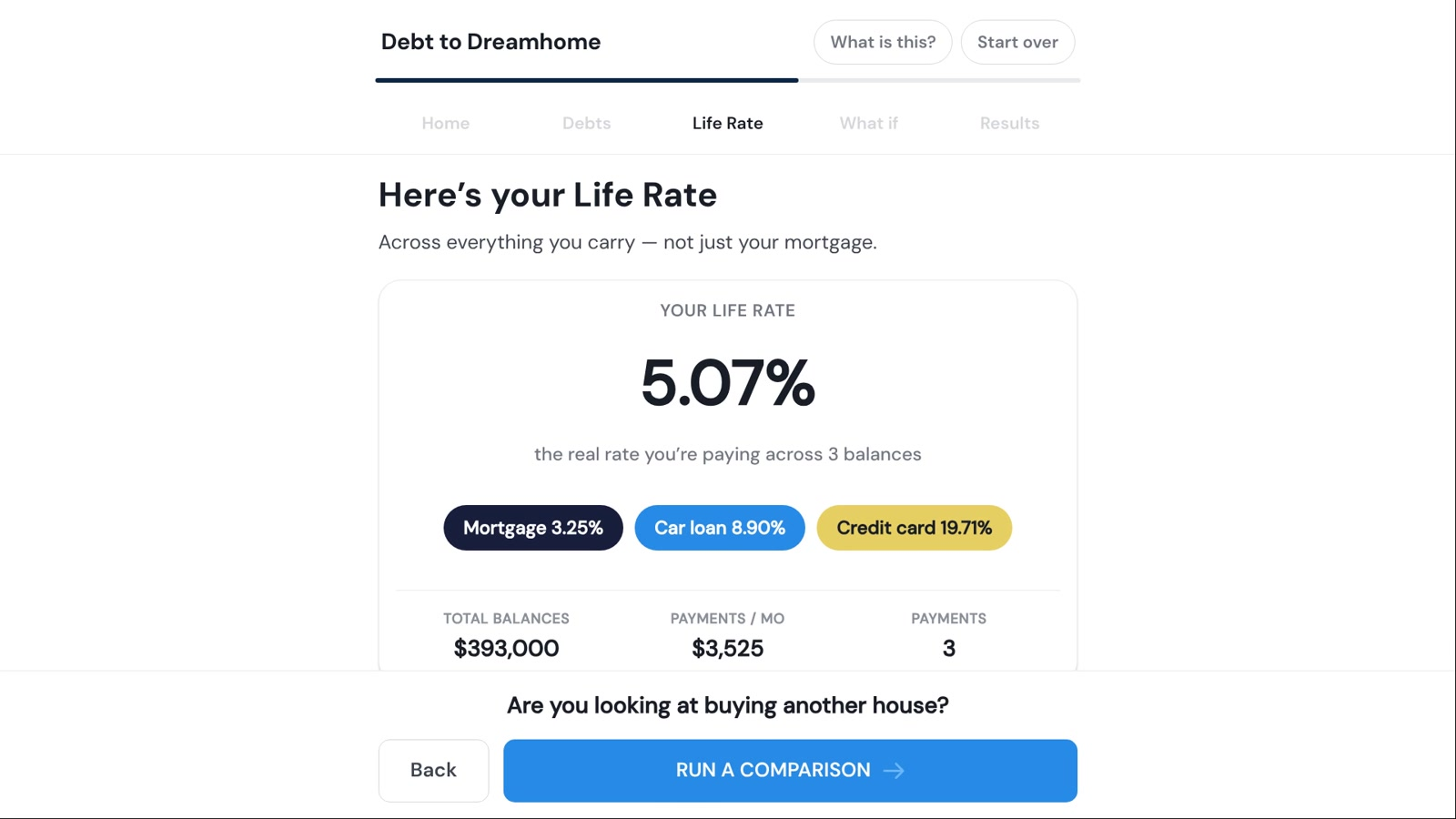
The car loan and the credit cards pull the real rate up to about 5%. That is still about 2 points below today’s mortgage rate, so for this household the low mortgage is doing a lot of work. Keeping it may be exactly right, which is why I don’t even run the “what if” for them.
Example 2: A Summerlin Household With a 7.16% Life Rate
Now a longtime Summerlin owner, also an example and not a real client. Their home is worth about what Summerlin West homes sold for in October, $795,000. They have had it a while, so the mortgage is down to $180,000.
| Debt | Balance | Rate |
|---|---|---|
| Mortgage | $180,000 | 3% |
| Two car loans | $62,000 | 9.5% |
| Credit card | $41,000 | 21.9% |
| Total | $283,000 | Life Rate 7.16% |
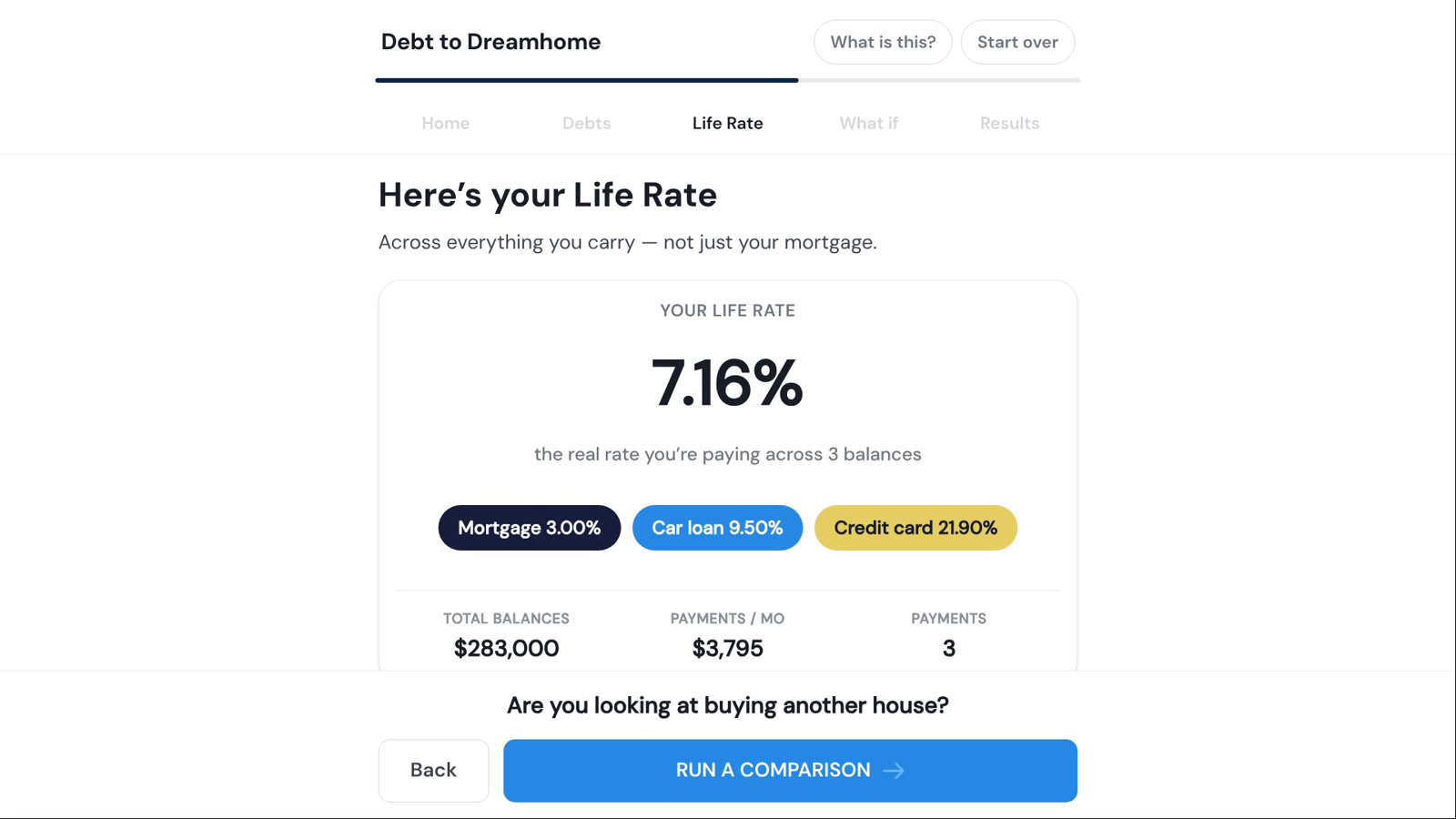
Their Life Rate is 7.16%. Today’s average 30-year rate is 7.18%. They are already paying about what a brand-new mortgage costs, just across 3 separate payments, about $3,800 a month.
What If the Summerlin Household Sells and Buys?
Say they want an $850,000 home in Summerlin at today’s rate, 7.18% for 30 years, and they pay off both car loans and the credit card at closing. After closing costs and paying off the mortgage, the calculator estimates about $559,000 in equity. It clears the $103,000 of debt and puts $85,000 down.
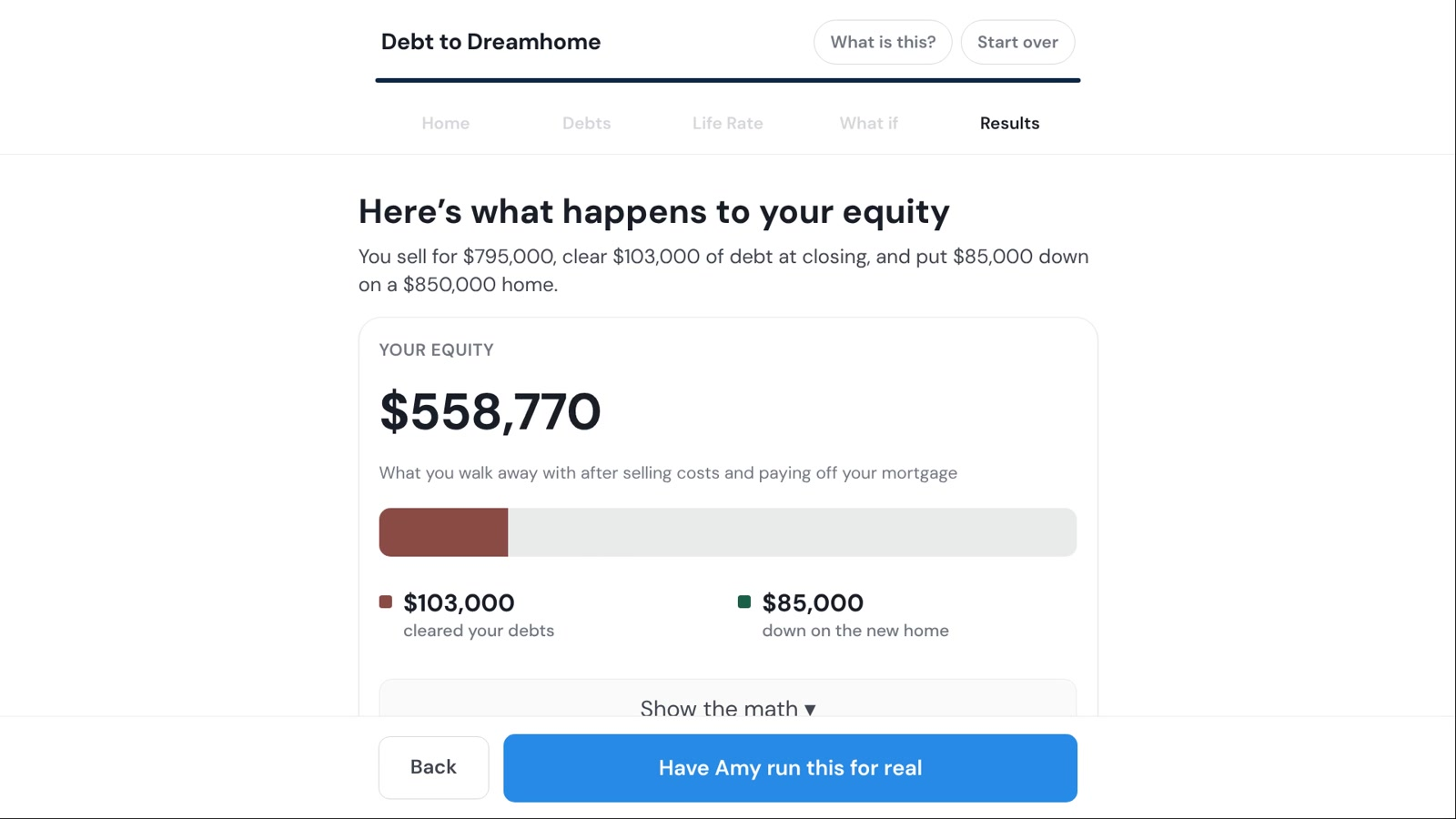
Three payments become one, and here is the honest part. In this example, the one payment is higher: about $5,180 a month in principal and interest, compared with about $3,800 today. That is about $1,387 more a month for a bigger home, and the Life Rate stays about the same, 7.18%.
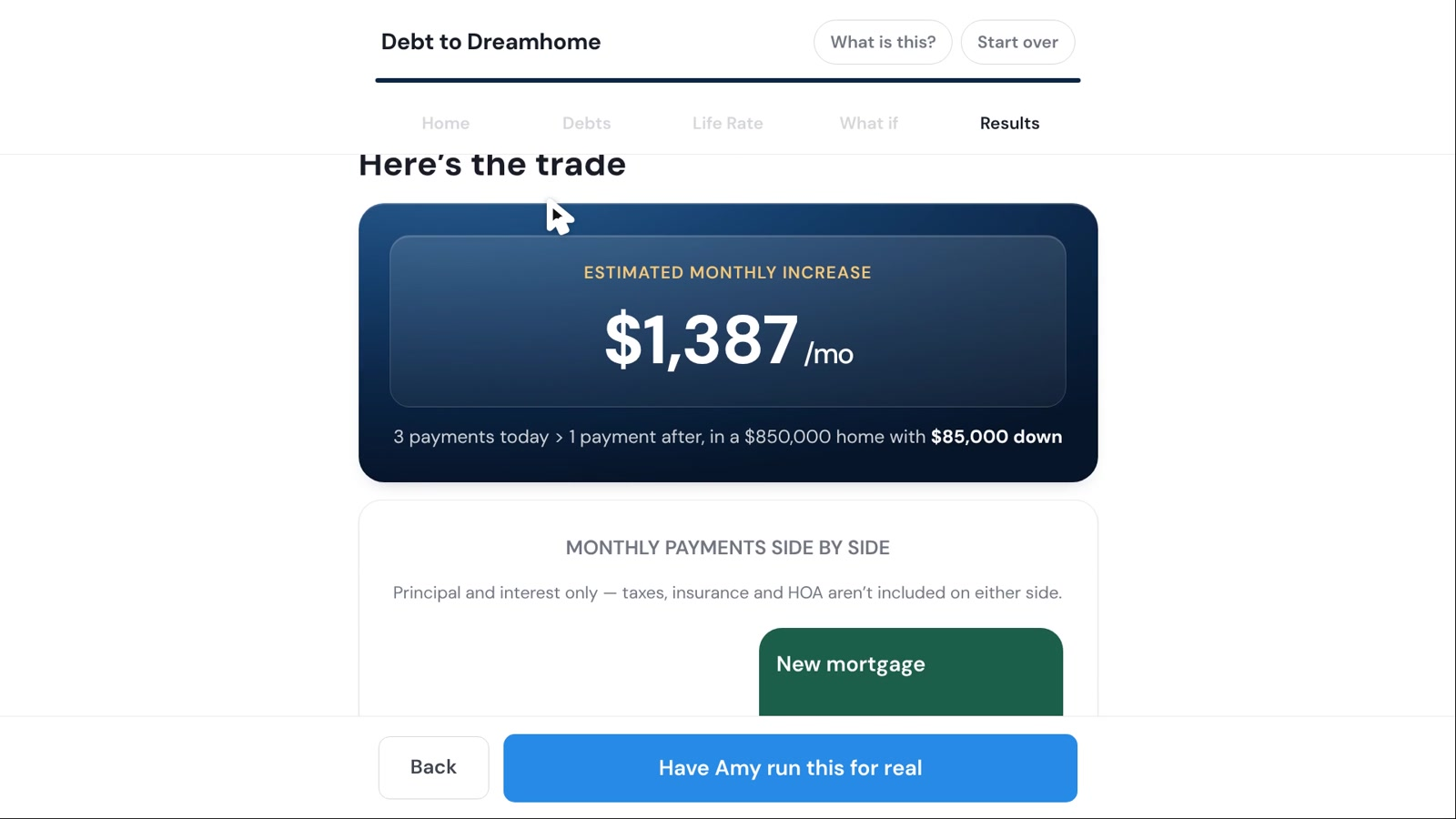
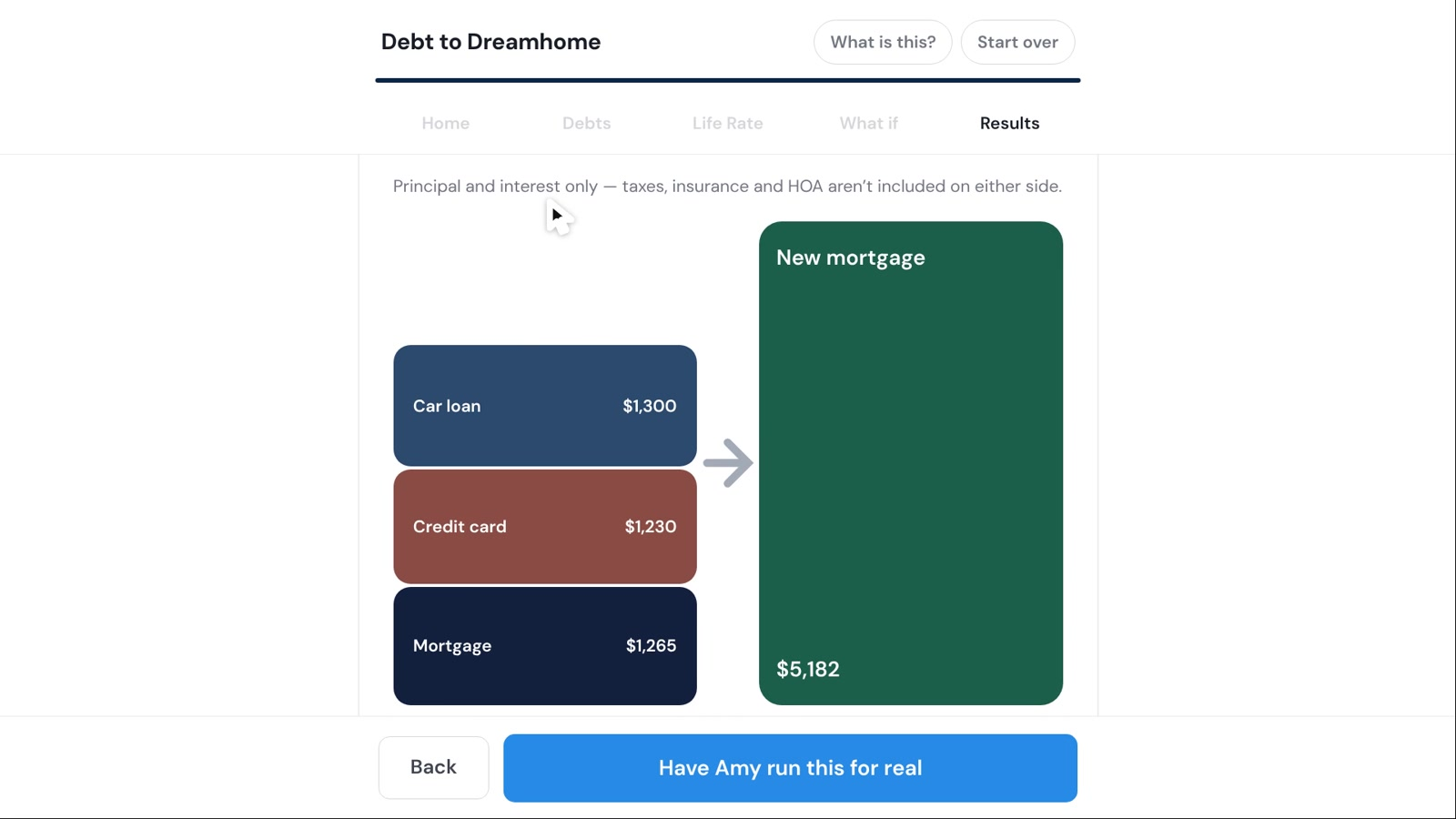
One thing to notice: the calculator puts 10% down. This household would have a lot more equity than that. If more of it goes into the new home, the new payment goes down. That is the conversation to have with a lender. For some households the math works. For others it doesn’t. This shows you which.
What the Rate Doesn’t Tell You
First, the rate isn’t the whole picture. Look at total monthly payments and how long you would be paying.
Second, if credit card or car debt goes into a mortgage, it is secured by your house, and you could be paying it for 30 years. That can cost more in total, even at a lower rate.
Third, selling and buying cost money: closing costs, moving, taxes. And if the spending that built the credit card debt doesn’t change, the debt comes back.
Fourth, in this market, price matters. In Summerlin West, the homes that were priced right sold in about 3 weeks. The ones that weren’t took over 2 months and a price cut. If selling is on the table, the plan starts with the right price. (More on that in when to cut your asking price in Las Vegas.)
Should I Keep My 3% Mortgage or Sell?
This isn’t “sell your house.” It is “know your number.” If your Life Rate is well below today’s rate, your low mortgage is working for you. If it is close to or above today’s rate, it is worth a real conversation with a lender about your real options: selling, refinancing, a HELOC, or keeping everything exactly as it is. Talk to a licensed lender and your tax professional before you decide.
If selling is part of the conversation, start with what your Las Vegas home is worth.
Frequently Asked Questions
A Life Rate is the weighted average interest rate across all of your debt, including your mortgage, car loans, credit cards, student loans and any HELOC. Each debt is weighted by the size of its balance.
Multiply each balance by its interest rate, add those amounts together, and divide by the total of all your balances. A simple average of the rates overstates it when high rates sit on small balances.
Your mortgage rate is the rate on one loan. Your Life Rate is the one rate across everything you owe. A homeowner with a 3% mortgage and high-rate car and credit card debt can have a Life Rate close to or above today’s mortgage rates.
Freddie Mac’s weekly survey put the average 30-year fixed rate at 7.18% on November 5, 2026. Update: Freddie Mac’s 30-year average is now 7.11% (Nov 12). The video’s numbers are as of Nov 5. Your own rate depends on your credit, down payment and loan type.
Not necessarily. It can make sense for some households and not for others. Compare total monthly payments, total cost over time, closing and moving costs, and taxes, and talk to a licensed lender and a tax professional before deciding.
The Las Vegas REALTORS October 2026 report put the single-family median at $475,000, basically flat from a year earlier and below the $490,000 record.
Want Me to Run Your Numbers With You?
Call or text me, 702-292-5904, and I will walk through your Life Rate with you, privately and for free. It stays between us. Or run it yourself at thearbeliteam.com/liferate and tap “Have Amy run this for real,” or DM me LIFERATE on Instagram (@amyarbeli).
Amy Arbeli, The Arbeli Team, Signature Real Estate Group. Amy Arbeli S.55419.LLC, Tzahi Arbeli S.0179386. Call or text 702-292-5904 | [email protected] | https://thearbeliteam.com
Amy is a Realtor, not a lender, financial advisor or tax professional. This article and video are for education only and are not a recommendation to buy, sell, refinance or consolidate debt. Moving unsecured debt into a mortgage secures it against your home and may cost more over time. Example households are illustrations, not real clients; calculator results are estimates. Summerlin West = ZIP codes 89138 and 89135. Data as of the dates shown and subject to change. Podcast recap in Amy’s own words; the views of Tom Ferry and David Childers are their own. Information deemed reliable but not guaranteed. Equal Housing Opportunity.
Full Video Transcript
Prefer to read? Here is the transcript of the video. It is auto-generated and lightly cleaned up.
If you own a home in Las Vegas with a 3% mortgage and you’re waiting for rates to come down, I want to show you a number you’ve probably never calculated. For some Summerlin homeowners, it’s already close to 7%. It is called your life rate. I’m Amy Arbeli with the Arbeli Team at Signature Real Estate Group here in Las Vegas. If you’re trying to figure out what the Las Vegas housing market means for you, subscribe. New Las Vegas videos every week.
I just watched Tom Ferry’s conversation with David Childers of Keeping Current Matters about the fall housing market. It’s linked below. They talked about the national numbers, so I’m taking each of those numbers and showing you what it looks like here in Las Vegas and in Summerlin. Then I’ll show you the one idea from that conversation every homeowner should run for themselves. One thing first, I’m a realtor, not a lender or a financial advisor. This is about understanding your numbers.
Any decision gets made with a lender and your tax professional. Number one, sales are slow, not frozen. Nationally, David Childers said, “We’ve had about 4 million home sales a year for 3 years in a row. Adjusted for population, that’s the slowest on record.” Here in Las Vegas, the Las Vegas Realtors October report shows 1,895 homes, condos, and townhomes sold. Home sales are down about 12% from last year.
And when we pulled the single-family MLS data ourselves, 1,476 homes sold in October, and 1,612 came off the market without selling. In Summerlin West, that’s zip codes 89138 and 89135, 78 sold and 105 came off unsold. Slow? Yes. Frozen? No. Homes that are priced right still sell. Number 2, buyers have leverage. Nationally, Redfin reported that in September, sellers outnumber buyers by 62.6%. That’s the biggest gap in their records going back to 2013. In Las Vegas, we have nearly 6 months of supply.
A year ago, it was about four and a half. There are 8,112 single-family homes on the market without an offer, up almost 8%. In Summerlin West, there are 519 active listing. That’s over 6 months of inventory at October’s pace, and 44% of the homes that sold there took a price cut first, typically about 6%. Number 3, prices are holding. Nationally, David’s point was that prices are flat or a little down in a lot of markets after huge run-ups. In Las Vegas, the median single-family price in October was $475,000.
That’s basically flat from a year ago and below the 490 record set this summer. In Summerlin West, the homes that sold had a median price of $795,000 in 42 days. The ones priced right from day one went under contract in 21 days. The ones that needed a cut took about 67. Number 4, rates aren’t coming down fast. Rates are national, so this one’s the same everywhere. As of November 5th, Freddie Mac has the average 30-year fixed at 7.18%. Fannie Mae’s October forecast has them averaging seven and a half through 2027.
Here’s what the president of Las Vegas Realtors, George Kypreos, said about October: “I suspect these statistics would look a lot different if rates went back down by a percentage point or so. Rates are the brake on this market.” Number 5, nobody is being forced to sell. Nationally, David said the average homeowner has about $310,000 in equity, and about 2 out of 3 mortgages are under 5%. That’s why he puts the chance of a crash, in his words, at 0.
In Las Vegas, distressed sales, meaning short sales and foreclosures, were 1.1% of October sales, and about 26% of buyers paid cash. That’s right in line with the national 27. So here’s where we are in Las Vegas. Prices are holding, buyers have more choices, rates are around seven, and the forecasts don’t show a fast drop. If you’ve got a 3% mortgage, you’re probably telling yourself to wait. Before you do, run one number. Tom Ferry calls it your life rate. Your mortgage rate is one rate and one loan.
Your life rate is the one rate across everything you owe: the mortgage, the car, the credit cards, the student loans, a HELOC. The math for each debt, multiply the balance by the rate. Add those up, divide by the total you owe. It’s weighted by how much you owe on each one. Some quick versions just average the rates. The weighted version is the accurate one. I use a calculator called Debt to Dream Home.
It figures your life rate, and then it shows what happens if you sell, pay off the debt, and buy the next house side by side, down to the monthly payment. Let me show you 2 households. This is an example, not a real client. A Las Vegas household with a home around the valley’s median, $475,000. So step one, the home worth $475,000. $320,000 left on the mortgage at three and a quarter percent. Step 2, everything else. A $45,000 car loan at eight point nine, and $28,000 on credit cards at 19.71%.
That’s Bankrate’s current national average. Step 3, their life rate is 5.07 percent. Their mortgage is three and a quarter, and the car and the credit cards pull the real rate up to about 5. That’s still about 2 points below today’s mortgage rate. For this household, the low mortgage is doing a lot of work. Keeping it may be exactly right. So I’m not even going to run the “what if” for them.
Now, a longtime Summerlin owner, if their home is worth about what Summerlin West homes sold for in October, $795,000, they’ve had it a while, so the mortgage is down to $180,000 at 3 percent. 2 car loans, $62,000 at nine and a half, and $41,000 on the credit card at 21.9. Their life rate is 7.16%. Today’s average 30-year rate is 7.18%. They’re already paying about what a brand-new mortgage costs across 3 separate payments, about $3,800 a month.
So let’s run the “what if.” Say they want an $850,000 home in Summerlin at today’s rate, 7.18%, 30 years, and they pay off both car loans and the cards, the credit cards, at closing. Here’s the result. After closing costs and paying off the mortgage, the calculator estimates about $559,000 in equity. It clears the $103,000 of debt and puts $85,000 down. 3 payments become one, and here’s the honest part. In this example, the one payment is higher, about $5,180 a month in principal and interest, compared with about $3,800 today.
That’s about $1,387 more a month for a bigger home, and the life rate stays about the same, 7.18%. One thing to notice, the calculator puts ten percent down here. This household would have a lot more equity than that. If more of it goes into the new home, the new payment goes down. That’s the conversation to have with a lender. That’s why you run the numbers. For some households, the math works. For others, it doesn’t. This shows you which.
And if you want me to run yours with your real numbers, there’s a button right here that sends it to me. Here’s what the rate doesn’t tell you. 1, rate isn’t the whole picture. Look at total monthly payments and how long you’d be paying. 2, if credit card or car debt goes into a mortgage, it’s secured by your house, and you could be paying it for 30 years. That can cost more in total, even at a lower rate. 3, selling and buying costs money, closing costs, moving, taxes.
And if the spending that built the credit card debt doesn’t change, the debt comes back. And 4, in this market, price matters. In Summerlin West, The homes that are priced right sold in about 3 weeks. The ones that weren’t took over 2 months and a price cut. So if selling is on the table, the plan starts with the right price. So this isn’t sell your house, it’s know your number, then sit down with a lender and look at your real options. That could be selling, refinancing, a HELOC, or keeping everything exactly as it is.
Here it is in under a minute. Nationally, sales are slow, and buyers have leverage. In Las Vegas, the median is $475,000, holding steady with nearly 6 months of supply. In Summerlin West, 44 percent of sales took a price cut first. Rates are around seven point one eight, and the big forecasts don’t show a fast drop. Your mortgage rate is your one loan. Your life rate is everything you owe weighted by the balance. If it’s well below today’s rate, your low mortgage is working for you.
If it’s close or above, it’s worth a real conversation with a lender. Either way, know your number. I’ll run it with you for free, and it stays between us. Call or text me. My number is below, or you can DM me life rate. Comment question, and I read every one. Before today, did you know your life rate? Yes or no? No numbers needed. Tom Ferry and David Childers’ full conversation is linked below, and my October Las Vegas market update with every Summerlin West number is right here.
I’m Amy Arbeli with the Arbeli Team, and I will see you on the next video.

Join The Discussion