 by
by 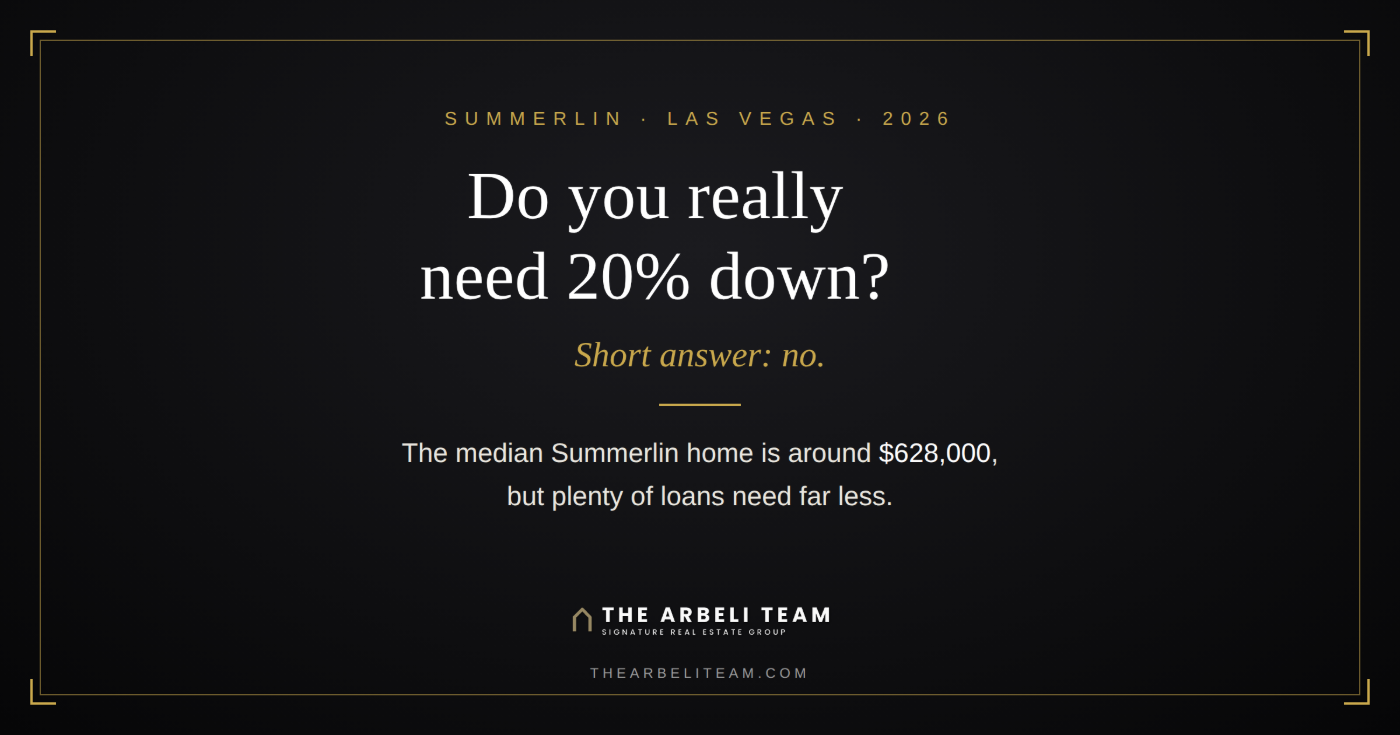
Short answer: You don’t need 20% down to buy in Summerlin. Plenty of loan programs let qualified buyers put down far less. But with the median Summerlin home sitting around $628,000 in 2026, the size of your down payment changes your monthly cost, your interest, and how strong your offer looks. Here’s how to think about it for our market, not a national average.
If you’ve been saving to buy near Downtown Summerlin, in The Vistas, or out in Summerlin West, you’ve probably heard the old rule: put 20% down. It’s one of the most repeated pieces of advice in real estate, and one of the most misunderstood.
The 20% “rule” isn’t actually a rule
You can buy a home in Las Vegas with far less than 20% down. Conventional loans go as low as 3-5%, FHA loans as low as 3.5%, and VA loans (big here, given Nellis and the veteran community) can go all the way to 0% for those who qualify. Nevada even runs a statewide down payment assistance program (Home Is Possible, through the Nevada Housing Division) for buyers who meet the income and credit guidelines.
So if almost nobody has to put 20% down, why do so many Summerlin buyers still do it?
Why Summerlin move-up buyers put more down
Here’s the pattern we see constantly with repeat buyers in the valley. Nationally, the typical repeat buyer puts down 23%, more than double the roughly 10% they put down as a first-time buyer (source: National Association of Realtors). The reason isn’t that they suddenly have more cash lying around. It’s equity.
When you’ve owned a home in Las Vegas for a few years, two things happen: you pay your mortgage down, and your home’s value climbs. Summerlin values are up about 3% year over year heading into 2026, on top of the appreciation many owners banked during the last few years. The gap between what you owe and what your home is worth is your equity, and when you sell, that equity becomes cash you can roll straight into the next down payment.
That’s the springboard. A first-time buyer doesn’t have it yet, and that’s completely normal. But if you already own here, you may be holding a lot more buying power than you realize.
Quick math on a median Summerlin home:
- 20% of $628,000 = $125,600
- 10% of $628,000 = $62,800
- 5% of $628,000 = $31,400
For a move-up buyer sitting on equity, that larger number is often already within reach.
4 real perks of putting 20% down in Las Vegas
If a bigger down payment is possible for you, here’s what you get in return (as Redfin also notes):
1. A smaller monthly payment. The more you put down, the less you borrow at today’s rates. On a $628,000 home, going from 10% down to 20% down means borrowing roughly $63,000 less. That’s real money off your payment every single month.
2. Less interest over the life of the loan. Put 20% down and you only pay interest on the remaining 80%. Put 5% down and you’re paying interest on 95%, which adds up to a lot more over 30 years.
3. No private mortgage insurance (PMI). On a conventional loan with less than 20% down, lenders tack on PMI, often a few hundred dollars a month depending on your loan. Hit 20% and PMI isn’t required, which frees up cash the day you close.
4. A stronger offer. This one matters right now. Summerlin homes are currently going pending in about 78 days and often selling a few percent under list, a more balanced market than we’ve had in years. In that environment, a larger down payment signals to sellers that your financing is solid and the deal is likely to close, which can win you the home (and sometimes a better price).
What if you don’t have 20%? (You still have great options)
Don’t let the 20% number scare you off, especially if you’re a first-time buyer. It is completely possible to buy a great home in the Las Vegas valley with 3-5% down, and here’s the honest tradeoff: you’ll likely pay PMI for a while, but you’re building equity and getting off the sidelines instead of waiting years to save a six-figure sum. You can always request to drop PMI later once you reach 20% equity, which, in an appreciating market like ours, can happen faster than you’d expect.
So how much should you put down?
Put down what fits your life, not what a national headline says. If you’re a first-time buyer, a smaller down payment can get you into the market sooner. If you’re moving up and your Summerlin equity makes 20% reachable, going bigger can lower your costs and make your offer stand out. Both can be the right call. It just depends on your numbers.
Frequently asked questions
Do you have to put 20% down to buy a house in Las Vegas?
No. Conventional loans start around 3-5% down, FHA around 3.5%, and VA loans can be as low as 0% for eligible buyers. Nevada’s Home Is Possible program can also help qualified buyers with down payment assistance.
What is the average down payment in Summerlin?
It varies by buyer. Nationally, first-time buyers put down about 10% and repeat buyers about 23% (NAR). On a median Summerlin home around $628,000, that’s roughly $62,800 to $125,600.
What is PMI and how do I avoid it?
Private mortgage insurance is a monthly fee lenders add on conventional loans when you put down less than 20%. You avoid it by putting 20% down, or you can remove it later once you’ve built 20% equity.
Is 2026 a good time to buy in Summerlin?
Summerlin has shifted toward a more balanced market, with homes taking around 78 days to go pending and often selling slightly below list, which gives buyers more room to negotiate than in recent years.
Bottom line
No, you don’t need 20% down to buy your next home in Summerlin. But you might want to. If your equity puts it within reach, a bigger down payment can lower your monthly cost, cut your interest, drop PMI, and make your offer stronger in today’s more balanced market.
The best next step is simple: have a local lender run your actual numbers, and let’s find out what your current home could add to your next down payment. We know this market street by street, so reach out anytime.
The Arbeli Team, Signature Real Estate Group
Housing data: Redfin (Summerlin median sale price, days on market) and the National Association of Realtors (down payment averages), 2026. This article is for general information and isn’t financial or lending advice; talk to a licensed lender about your specific situation.